

Permission vs. Progress: How Maine’s Certificate of Need Laws Limit Rural Healthcare
What Henry Ford and the Auto Industry Can Teach Us about Healthcare in Maine
The Declining State of Maine Healthcare
Across Maine, something quiet is happening.
It isn’t trending on social media.
It isn’t dominating headlines.
And yet, day after day, it makes itself known — first in living rooms, then along stretches of highway, and finally in crowded waiting rooms.
It appears when a parent waits weeks – and then months – for a petiatric appointment.
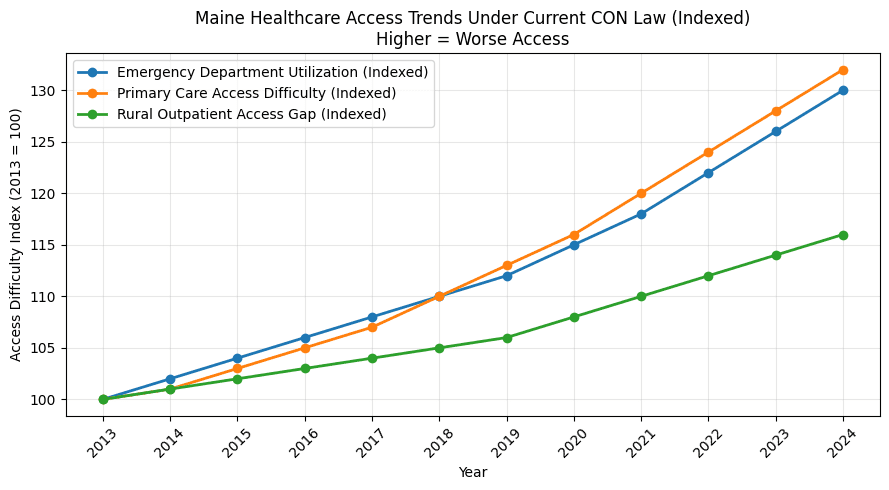
It shows its face when a senior is forced to drive hours just for routine imaging.
It glaringly stairs in the mirror of the veteran searching for mental health support within driving distance.
It lets its presence known when volunteer ambulances become the front door to care — not by design, but because there is no alternative.
Nowhere is this more visible than in rural Maine, where access to healthcare is becoming harder — not easier.
Primary care shortages continue to rise
Behavioral health gaps widenning.
Wait times continue their never ending strech.
Local options quietly disappear.
Taken together, these aren’t abstract trends. Instead, they form real barriers for real people – Maine people.
And while we’re often told this is simply the cost of being rural, that explanation only scratches the surface — because it doesn’t tell the whole story.
A Lesson From the Dawn of the Automobile
To truly understand what’s happening in Maine healthcare today, it helps to step back — far back — more than a century, to the dawn of the automobile.
At that time, in the early 1900s, cars were rare, expensive, and tightly controlled. A patent filed in 1895 by George B. Selden claimed to cover virtually all gasoline-powered automobiles in America. As a result, a powerful organization known as the Association of Licensed Automobile Manufacturers (ALAM) emerged to enforce it (Wikipedia, n.d.).
Through this structure, ALAM effectively decided who could build and sell cars — and who had to pay steep fees just to participate (Wikipedia, n.d.). On the surface, they framed their authority as protection, emphasizing safety and stability. In reality, however, it operated as a gatekeeping system that slowed innovation and limited access.
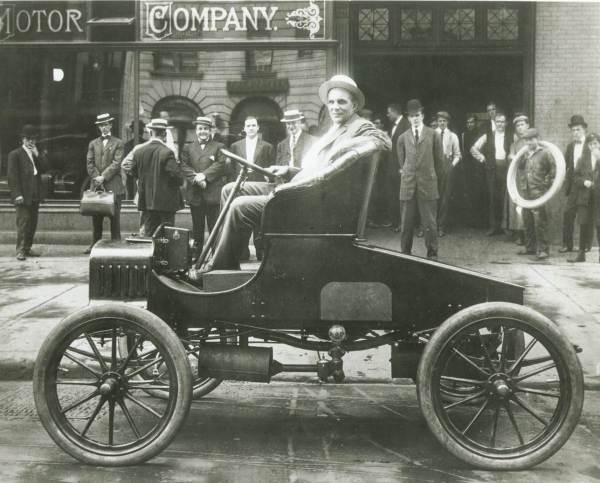
Then, into this closed marketplace, came Henry Ford.
Ford believed ordinary Americans deserved access to transportation. More importantly, he believed innovation belonged in the open market — not behind closed doors. So when he applied for a license and was rejected, he didn’t retreat. Instead, he stood his ground (HotCars, 2024).
Predictably, ALAM responded with a lawsuit. What followed was a drawn-out legal battle that stretched nearly eight years (The Henry Ford, n.d.).
Finally, in 1911, a federal appeals court ruled in Ford’s favor. With that decision, the sweeping reach of the Selden patent was dismantled, freeing automakers from mandatory royalties and opening the industry to competition (The Henry Ford, n.d.).
This wasn’t merely a legal victory. For the American consumer:
It opened a market.
It lowered prices.
It accelerated innovation.
And, over time, what had once been a luxury became a necessity.
In the end, Ford didn’t just defeat a cartel.
He dismantled a system built on permission.
And That Brings Us Back to Maine
Today, instead of automobiles, the controlled commodity is healthcare.
Instead of patent holders, we have regulatory boards.
Instead of ALAM, we have Certificate of Need laws — codified in Maine Revised Statutes, Title 22, Chapter 103-A. Under this framework, healthcare providers must obtain state approval before making major changes to services, facilities, or capital investments — from adding hospital beds to building new clinics or acquiring expensive equipment (Maine Legislature, 2026; Maine Department of Health and Human Services, n.d.).
These requirements — often referred to simply as CON — are intended to regulate growth in the healthcare marketplace. But in practice, they serve as obstacles to entry and expansion, especially for new or smaller providers.
Much like the Selden patent once did, Maine’s CON law decides who is allowed to build, expand, or offer services — and who must first ask permission. In theory, it exists to protect communities by preventing duplication and controlling costs. In practice, however, it often functions as a modern gatekeeping system (Pacific Legal Foundation, 2025; Maine Department of Health and Human Services, n.d.).
Before a new clinic can open…
Before imaging equipment can be added…
Before beds can be expanded…
Providers must prove to the state that their services are “needed,” meaning they must demonstrate that there is insufficient supply already in place.
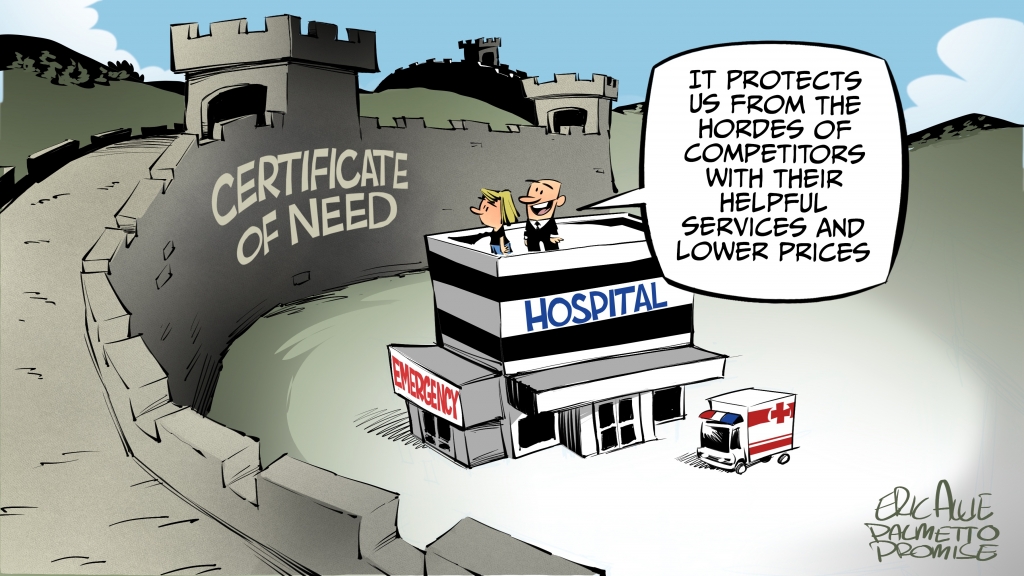
Here’s the catch: existing providers often weigh in on those decisions — meaning the very institutions facing competition can influence whether that competition is permitted at all (Pacific Legal Foundation, 2025).
As a result, innovation slows. Options shrink. Prices rise. And rural communities wait.
Where Maine Law Has Been and Where It’s Headed
In the 2025–2026 legislative session, lawmakers introduced LD 743 — An Act to Increase the Availability and Affordability of Health Care by Eliminating Certificate of Need Requirements (LegiScan, 2025; Maine Legislature, 2026), which would repeal Title 22, Chapter 103-A and remove the CON process entirely.
Supporters submitted testimony asserting that removing the CON requirement could increase availability and lower costs by promoting competition (Van Pate, 2025). Opponents, however, raised concerns about potential impacts on rural hospitals and other providers tasked with maintaining essential services (MaineHealth, 2025).
Although LD 743 was ultimately reported as “Ought Not to Pass” and did not become law in 2025, it reflects an ongoing debate in the State House over whether CON statutes help or hinder Maine’s healthcare system (LegiScan, 2025).
Recent legislative activity also includes LD 1890 (2025), which focuses on exempting certain ambulatory surgical facilities from CON requirements, showing that lawmakers continue to explore incremental reforms to Maine’s regulatory framework (FastDemocracy, 2026).
Similar efforts have been introduced in past sessions, such as LD 1554 in 2023, a bill to repeal CON requirements for healthcare providers (LegiScan, 2023).
What This Means for Rural Maine
Let’s be clear: hospitals matter. Emergency care matters. Safety nets matter.
But routine healthcare — imaging, outpatient procedures, primary care — thrives under competition.
When states have repealed or reformed CON laws, research shows significant increases in access. One recent working paper found that repealing CON laws for ambulatory surgical centers increased access statewide — especially in rural areas — reducing costs without evidence of hospital closures (Dupor, 2024).
That’s important because it suggests that fears competition will dismantle existing care networks aren’t reflected in the data.
What does show up is more options, more providers, and greater access where it’s needed most.
Related Reading
References
HotCars. (2024). How Henry Ford beat the Selden patent and changed the auto industry forever.
https://www.hotcars.com/how-henry-ford-beat-selden-patent/
The Henry Ford. (n.d.). Selden patent trial.
https://www.thehenryford.org/collections-and-research/digital-resources/popular-topics/selden-patent/
Wikipedia. (n.d.). Association of Licensed Automobile Manufacturers.
https://en.wikipedia.org/wiki/Association_of_Licensed_Automobile_Manufacturers
Maine Legislature. 22 MRSA Chapter 103-A: Certificate of Need.
https://legislature.maine.gov/statutes/22/title22ch103-Asec0.html
Maine Department of Health and Human Services. Healthcare Oversight – Certificate of Need.
https://www.maine.gov/dhhs/dlc/healthcare-oversight
Maine Policy Institute. How Maine’s Certificate of Need Law Could Limit Patient Access.
https://mainepolicy.org/how-maines-certificate-of-need-law-could-limit-patient-access-to-treatment-amid-coronavirus-outbreak/
LegiScan. (2025). LD 743 – An Act to Increase the Availability and Affordability of Health Care by Eliminating Certificate of Need Requirements.
https://legiscan.com/ME/bill/LD743/2025
Maine Legislature – BillTrack50. LD 743.
https://www.billtrack50.com/billdetail/1843513
Maine Legislature – BillTrack50. LD 1554.
https://trackbill.com/bill/maine-legislative-document-1554-an-act-to-repeal-certificate-of-need-requirements-for-health-care-providers/2416157
Maine Legislature – FastDemocracy. LD 1890: Exempting Certain Ambulatory Surgical Facilities from CON Requirements.
(Provides context on related CON changes) https://fastdemocracy.com/bill-search/me/132/bills/MEB00015315/