

If Politics Were Baseball: Rethinking Democracy
Setting the Scene
Imagine, for a moment, what would happen if we stopped treating politics like a battlefield and started treating it like baseball. Instead of bracing for conflict, we could lean in with curiosity. Instead of fearing division, we could study performance. And instead of dreading another election cycle, we could actually enjoy the season as it unfolds.
Right now, politics often feels heavy — not just complicated, but exhausting. It weighs on people. The constant noise, the tension, the finger-pointing, the sense that every issue is a crisis and every disagreement a battlefield… it wears us down. Many folks feel like they’re stepping into an arena they never asked to enter, where the rules keep shifting and the scoreboard never makes sense. Said another way, it is a huge turnoff.
But something remarkable happens when we step back and reframe the whole experience through the lens of America’s favorite pastime. Suddenly, the picture changes. Baseball reminds us that life doesn’t have to be lived at a sprint or a shout. Instead, it moves at a human pace — slow enough to think, steady enough to breathe, and familiar enough for everyone to follow.
When we look at civic life the way we look at a season of baseball, it becomes relatable, almost comforting. We already understand how to track growth, measure effort, and celebrate progress. We know how to appreciate the long game. And just like that, politics — which so often feels like a burden — starts to look a little more like something we already know and enjoy.
So let’s step up to the plate and imagine this world together.
Pre-Season: Campaigning and Preparation
Before any player steps onto the field for Opening Day, they endure pre-season—weeks of conditioning, drills, practice games, and team-building. In politics, the same rhythm exists.
Pre-season begins long before Election Day. Candidates gather signatures, knock on doors, hold small meet-and-greets, and speak at community events. They practice explaining their values. They take feedback. They adjust their swing. They sharpen their message.
More importantly, they build relationships.
Campaigning isn’t about conquering ground; it’s about earning trust, house by house and handshake by handshake. Just like spring training, pre-season teaches endurance, humility, and resilience. It reveals who’s prepared and who’s simply hoping their name carries them through the year.
And by the time pre-season ends, voters already have an early sense of who’s ready to play ball.
The Minors: Where Future Leaders Learn the Game
Before anyone hears their name announced in the big leagues, they almost always spend time in the minors. That’s where habits form, confidence grows, and character is tested.
The minors in civic life operate the same way.
Local boards, school committees, planning commissions, church groups, food pantries, and volunteer fire departments — these are just a few examples of our minor leagues. They develop the next generation of leaders long before a statewide or national spotlight finds them.
Serving in the minors teaches a person how to:
- Listen when people disagree
- Solve real problems with limited resources
- Work across personalities and backgrounds
- Stay humble, steady, and focused
Most importantly, the minors root leaders deeply in the community. Because when you’re working alongside neighbors — not cameras — you learn quickly what matters most to them.
And just like baseball, nobody skips the minors and gets better.
The fundamentals start here.
Opening Day: Putting Preparation Into Action
First, picture the start of a legislative session as Opening Day. Instead of frustration, we’d feel excitement as the doors swing open. Immediately, people would ask:
Who will lead off?
Who’s ready to deliver?
Who practiced in the offseason?
As the “regular season” unfolds, lawmakers constantly step back into the box. They swing at new ideas. They advance tough conversations. They sacrifice for the community when necessary. And because the work happens in full view of the fans, their effort actually matters.
More importantly, this approach reminds us that governing isn’t a one-night event — it’s a long, steady season built on daily decisions.
The Scoreboard and Keeping Stats
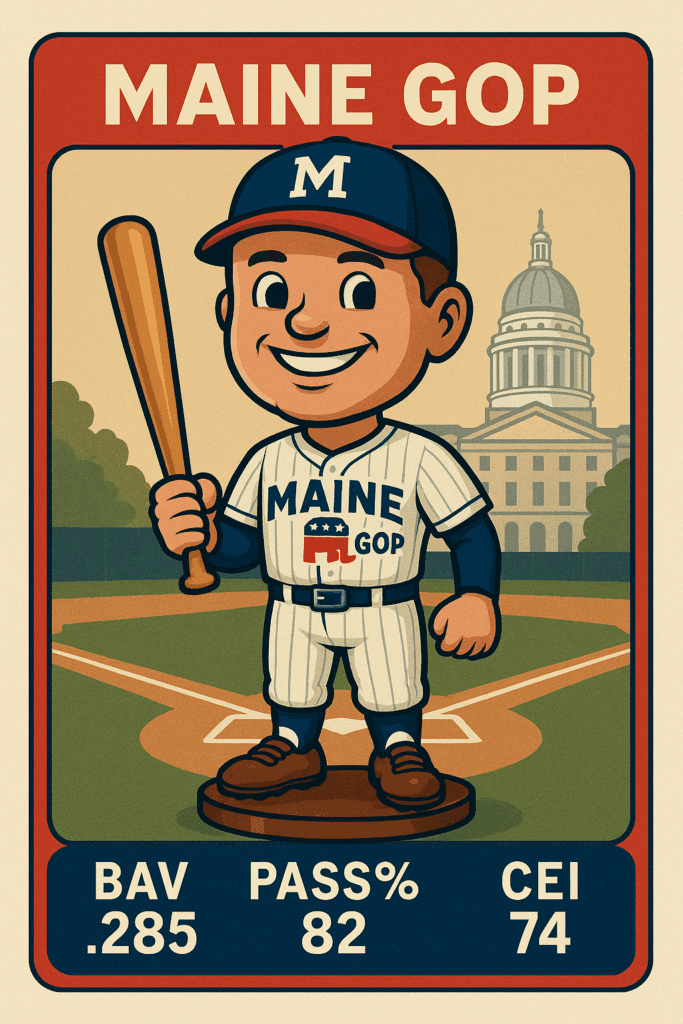
Next, imagine what would happen if we displayed political performance the way baseball showcases its stats. Baseball fans track everything; meanwhile, political conversations often rely on rumor, emotion, or guesswork.
Instead, we could easily adopt a transparent scoreboard:
BAV — Bills At-Bat
How often did your representative step up and propose and/or support something meaningful?
PASS% — Pass Rate Percentage
How many of their ideas actually crossed home plate and became law?
CEI — Constituent Engagement Index
Did they hold town halls?
Did they return calls?
Did they show up even when it wasn’t convenient?
BOB — Bipartisan On-Base
How often did they work across the aisle instead of retreating to a dugout?
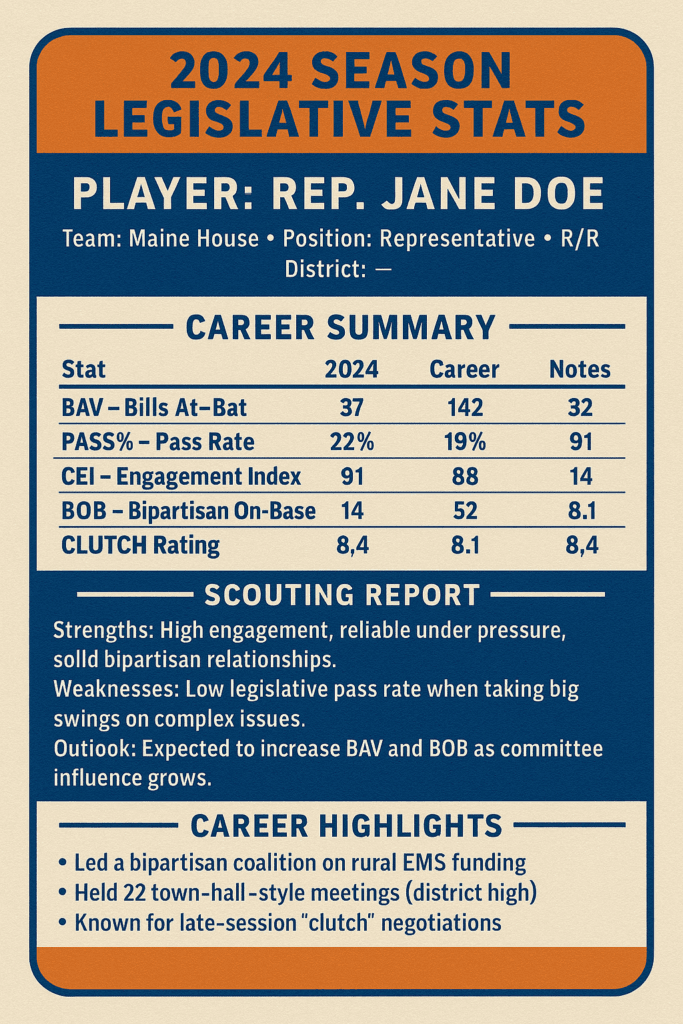
CLUTCH Rating
When pressure mounted, did they rise to the moment or disappear?
By introducing these metrics, we shift the conversation. As a result, we focus less on personality and more on performance. And with clearer data, voters gain the ability to evaluate leadership the same way fans analyze athletes — not through partisanship, but through results.
The Fans in the Stands: Democracy at Its Best
As we continue imagining this world, the most important transformation becomes clear:
the voters become the fans, and therefore, the real owners of the team.
You choose the lineup.
You decide who plays shortstop and who stays on the bench.
And yes — you ultimately send folks back to the minors if they stop delivering.
When voters embrace that role, everything changes. Suddenly, civic life becomes communal rather than confrontational. Instead of fueling arguments, people trade insights. Instead of yelling online, neighbors talk about what actually happened during the season.
Most importantly, this shift empowers you — because in this analogy, the fans truly run the franchise.
Post-Season: A Time to Reflect and Make Adjustments
As the season draws to a close, everything slows just enough for people to look back and take stock. The games have all been played. The lineups have shifted. There were good innings and tough ones, clutch moments and missed opportunities. And now the community begins to reflect — not with frustration or noise — but with the steady clarity that comes after a long season on the field.
This is when people start asking the honest questions:
Who showed up and gave it their all?
Who improved as the season went on?
Who lifted others up and kept the team together?
Who adjusted when the game changed, instead of repeating the same play over and over?
These aren’t political questions. They’re baseball questions — the kind you ask when you genuinely care about the strength and future of the team.
Because every season, no matter how it unfolds, eventually brings the same decision:
Who should lead us into the next one?
Who has earned the trust, the respect, and the confidence of the community to wear the captain’s “C” on their jersey?
Choosing leadership for the next season isn’t about punishing mistakes or rewarding popularity. It’s about evaluating the whole body of work — the discipline, the teamwork, the commitment to fundamentals, and the willingness to step up when the team needed a spark.
When a community reviews the season from this perspective, performance naturally rises above politics. The chatter fades, the highlight reels settle, and what remains is the consistency of effort over time.
And that’s the heart of a healthy team — and a healthy democracy:
a shared commitment to choosing leaders based not on noise, but on how they played the game all season long.
A More Joyful Democracy
Ultimately, this entire thought experiment leads to one clear truth: baseball gives us a blueprint for a more joyful democracy.
Like baseball, politics could slow down long enough for people to think. It could encourage teamwork instead of division. And it could remind us that progress happens through steady practice, not sudden perfection.
Imagine neighbors tracking legislative “box scores” instead of posting insults.
Imagine debates grounded in performance instead of outrage.
Imagine town meetings that feel more like tailgates — filled with energy, belonging, and a shared sense of purpose.
At the end of the day, this is what we all hope for:
a community that competes together, learns together, and ultimately wins together. Because—as Jackie Robinson reminded us—“A life is not important except in the impact it has on other lives.” When we approach civic life with that spirit, the game changes.
So let’s take the first step.
Let’s build a political culture that feels less like a battlefield and more like a ballpark where neighbors gather, cheer, and invest in something bigger than themselves. Let’s celebrate the good plays, learn from the hard innings, and show up for the teammates who give their full effort day after day.
When we lead with impact, humility, and a little teamwork, we don’t just improve our politics—
we strengthen the entire community that depends on it.
Because whether we admit it or not, we’re all rooting for the same team:
Our community — today, tomorrow, and every season ahead.